


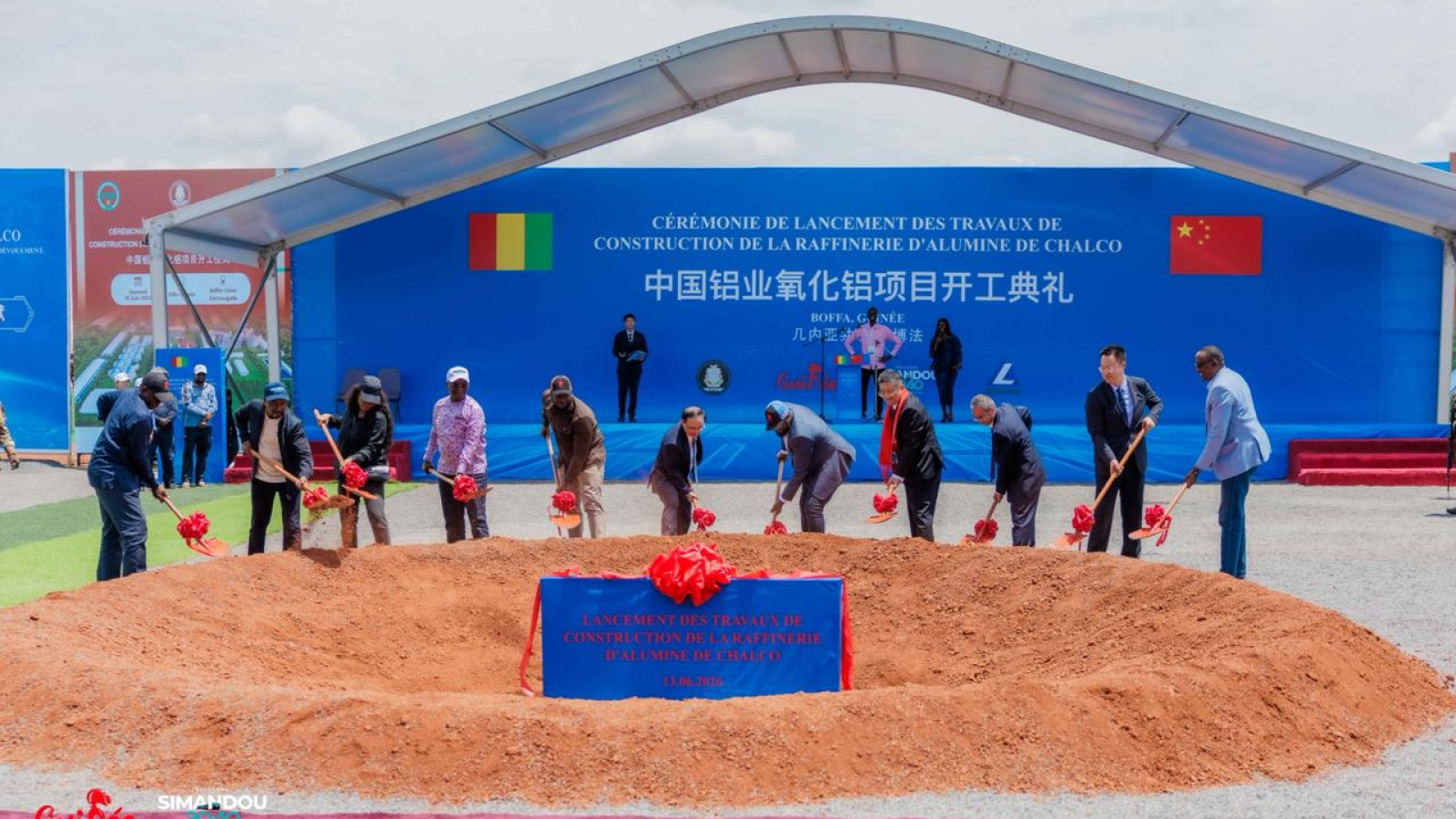
BOFFA, Guinea – Guinea has reached another significant milestone in its drive to transform its mining sector from a raw material exporter into an industrial value-adding economy, with the official launch of construction works for the Chalco alumina refinery in Boffa.
The groundbreaking ceremony, held on 13 June 2026, marks the start of a US$1 billion industrial project that will have a production capacity of 1.2 million tonnes of alumina per year. Developed by Chalco Hong Kong, an investment arm of China Aluminium Corporation (Chinalco), the refinery is expected to become a key component of Guinea’s emerging downstream aluminium industry.
The project follows the signing of refinery agreements between the Government of Guinea and Chalco on 21 May 2026 in Conakry and demonstrates the rapid implementation of commitments made under the country’s industrialisation agenda. The ceremony was co-chaired by General Amara Camara, Minister Secretary-General of the Presidency, and Djiba Diakité, Minister Director of Cabinet and President of both the Strategic Committee for Simandou and the Sino-Guinean Framework Agreement.
Located approximately 40 kilometres from Boffa town, the refinery will be supplied by the region’s abundant high-grade bauxite resources. Once operational, it will convert locally mined bauxite into alumina, a higher-value intermediate product used in aluminium smelting, reducing Guinea’s long-standing dependence on the export of raw ore.
The refinery represents the third major alumina refining project launched in Guinea under the leadership of President Mamadi Doumbouya, following initiatives led by SPIC and the Winning Consortium. Together, these projects signal a structural shift in Guinea’s mining strategy toward local beneficiation and industrial development.
According to the Ministry of Mines and Geology, the project is expected to generate approximately 1,000 direct jobs and 1,200 indirect jobs. Beyond employment, Chalco has committed to supporting human capital development through 500 scholarships over a 20-year period and the construction of an engineering and technical training school in Boffa capable of training 100 students annually in each discipline over the next decade.
For Chinalco, already present in Guinea through its Boffa bauxite operations and participation in the Simandou iron ore project and the Compagnie du Transguinéen (CTG), the refinery strengthens its integrated presence across the country's mining value chain. The project also reinforces Guinea’s growing importance within the global aluminium supply chain.
A Strategic Turning Point for Guinea
The significance of the refinery extends well beyond its industrial footprint. For decades, Guinea has been the world's leading supplier of bauxite while capturing only a fraction of the value generated from its mineral resources. The development of alumina refining capacity offers an opportunity to retain a larger share of mining value within the national economy.
Alumina refining creates substantially more economic activity than the extraction and export of raw bauxite alone. It generates skilled employment, stimulates local procurement, increases tax revenues, encourages infrastructure development and promotes technology transfer. The refinery could also become a catalyst for the growth of industrial clusters and supporting service industries in the Boffa region.
The project's emphasis on scholarships, technical education and workforce development is particularly important. The long-term success of Guinea’s industrialisation strategy will depend not only on infrastructure investments but also on the availability of a skilled national workforce capable of operating increasingly sophisticated industrial facilities.
The Path Forward: From Projects to Industrial Transformation
While the launch of the Chalco refinery is a major achievement, its ultimate success will depend on effective execution and sustained collaboration between government, investors and local communities.
For the Government of Guinea, priorities should include ensuring reliable power supply, strengthening transport and logistics infrastructure, enforcing environmental and social standards, and maintaining a predictable regulatory framework that supports long-term investment. Equally important is the rigorous implementation of local content policies to maximize opportunities for Guinean workers and businesses.
For mining companies, the challenge extends beyond constructing industrial facilities. Operators must invest in workforce training, supplier development and community engagement while ensuring international best practices in environmental management and sustainability.
The launch of the Chalco refinery demonstrates that Guinea is moving decisively toward mineral beneficiation and industrial development. If successfully implemented, this project, alongside other refining initiatives under the Simandou 2040 vision, could help transform Guinea from a major exporter of raw minerals into one of Africa’s leading mining and industrial economies, creating lasting benefits for future generations of Guineans.
Share on social media

-