


Rio Tinto SimFer has reported significant progress across key components of the Simandou iron ore project, reinforcing confidence that one of Africa’s largest mining and infrastructure developments remains on track to deliver first exports within the planned timeframe.
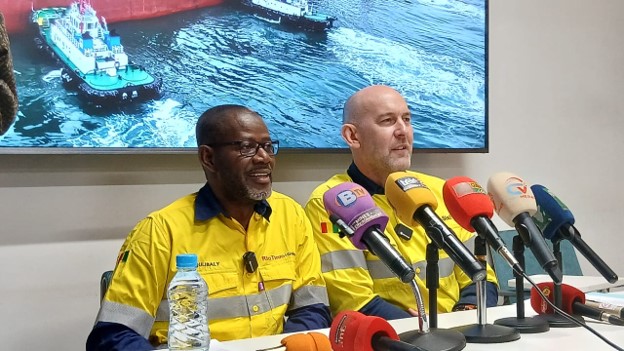
During its quarterly media briefing held on March 26, 2026, SimFer executives highlighted major achievements across the mine, railway and port infrastructure, while emphasizing the project’s growing contribution to Guinea’s workforce development and broader economic transformation.
Speaking to journalists, SimFer Managing Director Chris Aitchison and Rio Tinto Guinea Country Director Aboubacar Koulibaly described the project’s progress as highly encouraging, with several critical construction milestones already completed and others advancing ahead of schedule.
Rail Infrastructure Milestone Achieved
Among the most significant developments announced was the completion of the railway spur connecting the Simandou mine to the Transguinean Railway, a strategic link that will enable the transport of iron ore from the remote Simandou mountain range to the export terminal on Guinea’s Atlantic coast.
According to Aitchison, construction of the rail spur has been fully completed and formally handed over, marking the end of a major phase in the development of the integrated mining corridor.
The completion of this infrastructure is a critical achievement for the Simandou project, which relies on a vast logistics network to transport high-grade iron ore from southeastern Guinea to international markets. The Transguinean Railway, extending more than 600 kilometres across the country, is widely regarded as one of the most transformative infrastructure investments ever undertaken in Guinea.
Mine Construction Advances Ahead of Schedule
At the mine site, construction of permanent operational facilities is progressing rapidly. SimFer reported strong progress on primary and secondary crushing plants, stockyard facilities and train-loading systems, all of which are essential components of future production operations.
Aitchison indicated that construction activities are advancing ahead of schedule, with commissioning of the permanent crushing infrastructure expected to begin during the second half of 2026.
The announcement is particularly noteworthy given the scale and complexity of the Simandou development. Building a large-scale mining operation in a remote region with challenging terrain and significant logistical requirements has required extensive coordination among contractors, suppliers and project teams.
The ability to maintain schedule performance suggests that project execution remains robust despite the challenges typically associated with mega-project developments.
Moribaya Port Nears Critical Completion Stage
Substantial progress has also been achieved at the Moribaya port facilities, which will serve as the export gateway for Simandou iron ore.
According to SimFer, the main wharf structure is now largely complete, while three shiploaders have already been installed. Key systems including wagon unloading facilities, stockyards and ore-handling equipment are also approaching final construction stages.
The company expects port construction to be completed during the second half of 2026, with commissioning targeted for the first quarter of 2027.
The port represents a crucial component of the Simandou logistics chain. Once operational, it will support the efficient export of large volumes of high-grade iron ore to global steelmaking markets, positioning Guinea among the world's leading iron ore exporters.
Despite the approaching rainy season and the immense scale of construction activities, company officials expressed confidence that the project remains aligned with its development schedule.
Building a Guinean Workforce for the Long Term
Beyond physical infrastructure, Rio Tinto SimFer emphasized workforce development as a cornerstone of its long-term strategy.
Aitchison noted that the company is investing not only in infrastructure but also in developing the technical capabilities required to operate and maintain complex mining and logistics assets over the life of the project.
One example highlighted during the briefing was the training of young Guinean maritime professionals in China. These trainees are being prepared to operate transshipment vessels that will play a key role in Simandou’s export operations.
The initiative reflects a broader strategy aimed at transferring technical knowledge and creating a pipeline of skilled national professionals capable of assuming leadership positions across mining, maintenance and logistics functions.
As the project moves closer to production, the development of local expertise will be essential to maximizing national participation in long-term operations and ensuring sustainable economic benefits beyond the construction phase.
Local Employment Reaches 77 Percent
Aboubacar Koulibaly underscored the project's socio-economic impact, revealing that Guinean nationals currently represent approximately 77% of the project's workforce.
With total employment estimated at around 20,000 workers, the figures highlight the substantial role Simandou is already playing in job creation across the country.
In addition to direct employment, the project has supported investments in schools, healthcare facilities and community infrastructure, particularly in the prefectures of Beyla and Forécariah. The company also continues to support capacity-building initiatives for public-sector officials involved in natural resource governance.
The strong localization rate is particularly significant given the specialized skills required for large-scale mining and infrastructure construction projects. Continued investment in training and workforce development is expected to further increase national participation over time.
A Transformational Investment for Guinea
With an estimated investment approaching US$20 billion, Simandou remains one of the largest mining investments currently under development globally and the largest in Guinea’s history.
According to Koulibaly, the project should be viewed as a multi-generational economic development initiative rather than simply a mining operation. Beyond iron ore production, the project is expected to stimulate local procurement, subcontracting opportunities, logistics services and broader industrial development.
Industry observers note that successful delivery of Simandou could significantly strengthen Guinea’s position as a major global mining jurisdiction while improving the country's attractiveness to international investors across multiple sectors.
The integrated mine-rail-port model is also expected to generate substantial fiscal revenues, support regional development and accelerate economic diversification over the coming decades.
Maintaining International ESG Standards
Responding to questions regarding environmental and social performance, Rio Tinto representatives reiterated their commitment to applying the same environmental, social and governance (ESG) standards in Guinea as those implemented across the company’s global operations.
Company officials emphasized ongoing engagement with local communities, civil society organizations, government institutions and media stakeholders as a critical component of responsible project development.
Maintaining constructive dialogue and addressing stakeholder concerns will remain essential as construction activities intensify and the project transitions toward commissioning and production.
Looking Ahead
As SimFer advances toward completion of key infrastructure assets, the Simandou project continues to move from vision to reality. The successful completion of the railway spur, rapid progress at the mine and port, and continued investment in Guinean talent collectively demonstrate growing momentum behind a project that is expected to reshape Guinea’s mining sector and economic landscape.
With major construction milestones anticipated during the second half of 2026 and commissioning activities scheduled to accelerate through 2027, the coming months are likely to represent a defining phase in the development of what many industry participants consider one of the world's most significant iron ore projects.
Share on social media

-