


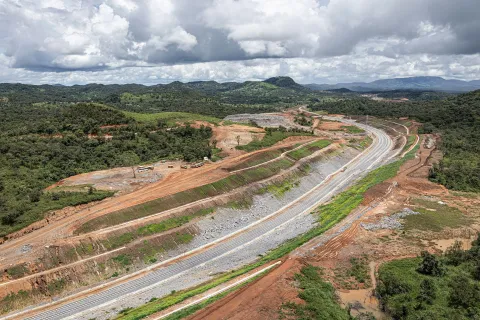
Conakry, Guinea — Guinea’s mining sector is entering a transformative phase, driven by large-scale investments in infrastructure, rising global demand for critical minerals, and renewed efforts to position the country as a strategic supplier to international markets. As projects expand across bauxite, iron ore, and gold, industry observers say the coming years could redefine Guinea’s role in the global mining economy.
Guinea possesses some of the world’s largest reserves of bauxite—the primary raw material used in aluminum production—and significant deposits of high-grade iron ore and gold. The country has long attracted international mining companies, but limited infrastructure and logistical constraints have slowed the full exploitation of its mineral wealth.
Recent developments suggest this may be changing.
One of the most closely watched projects remains the Simandou Project, often described as one of the largest untapped high-grade iron ore deposits globally. The project has triggered major investments in railway networks and port infrastructure designed to transport ore from inland regions to export terminals along the coast.
Analysts believe these infrastructure developments could create benefits beyond mining itself.
“The expansion of transport corridors may improve connectivity, stimulate local businesses, and support broader economic activity,” noted regional economic observers. Improved rail and port systems could eventually facilitate agricultural exports and regional trade, potentially diversifying economic opportunities.
Rising Global Demand Supports Guinea’s Position
International demand for aluminum and steel inputs continues to shape interest in Guinea’s mineral sector. Growth in renewable energy systems, electric vehicles, and construction industries has sustained demand for metals requiring bauxite and iron ore.
China remains one of the largest importers of Guinean bauxite, while investors from the Middle East, Asia, and Europe increasingly monitor opportunities linked to long-term supply security.
Mining executives have emphasized that stable production and infrastructure efficiency will be essential if Guinea hopes to strengthen competitiveness against other resource-rich nations.
Opportunities and Challenges
Despite optimism, challenges remain.
Communities located near mining zones frequently raise concerns regarding environmental management, land use, and equitable distribution of economic benefits. Expectations around local employment, social investment programs, and sustainable practices continue to grow.
Environmental experts also highlight the importance of stronger monitoring systems to reduce impacts associated with mining operations, including dust emissions, water management, and land rehabilitation.
At the same time, policymakers face pressure to balance foreign investment attraction with increased local value creation through processing and downstream industries.
Some observers argue that Guinea’s long-term success will depend not only on exporting raw minerals but also on developing industrial capacity capable of generating higher-value products domestically.
A Critical Period Ahead
The next decade may prove decisive for Guinea’s mining future.
If infrastructure projects advance as planned and governance reforms continue, Guinea could strengthen its position among the world’s most influential mineral-producing nations. Increased transparency, sustainable practices, and local economic integration are likely to become key indicators of success.
For investors, industry operators, and communities alike, the central question remains whether Guinea’s current mining momentum can translate into durable economic growth.
As global competition for strategic minerals intensifies, Guinea stands at a pivotal moment—one where geology, infrastructure, and policy may together shape the country’s next chapter.
Why this story matters: Mining contributes significantly to Guinea’s economy, and developments in major projects may influence employment, foreign investment, infrastructure growth, and export revenues across the country.