
Sand-mining operations along the Makona River have been suspended following a border confrontation between Liberian contractors and Guinean security forces, raising concerns over jurisdictional boundaries and operational continuity in the cross-border mining corridor.
The incident, involving BK Enterprise — a company engaged in sand excavation along the Makona River in Foya District, Lofa County — escalated when armed Guinean soldiers crossed into the area, forcibly halted operations, and seized the contractor's mining equipment. Guinean authorities asserted territorial claims over the river section being worked, citing it as falling within Guinea's jurisdiction.
The forced stoppage underscores a persistent challenge faced by junior and artisanal operators in frontier zones: the absence of clearly demarcated, operationally recognized boundary frameworks governing riverine resource extraction. The Makona River, straddling the Liberia-Guinea border, has long served as a geographic and political flashpoint, and the latest incident highlights the regulatory vacuum that can expose mining operators to abrupt, state-enforced work stoppages.
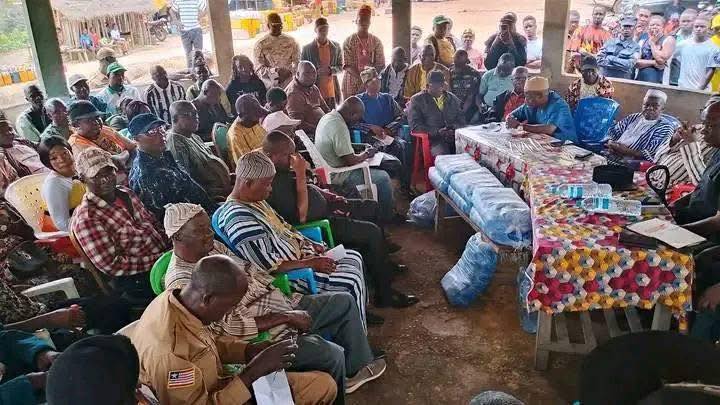
In response to the escalation, Liberia's Internal Affairs Minister, Hon. Francis Sakila Nyumalin, led a high-level inter-agency delegation — comprising senior government officials, security leadership, and Lofa County representatives — to Guéckédou, Guinea, on March 8, 2026. At the diplomatic level, both governments reaffirmed bilateral ties and engaged on the historical context of the Makona River boundary. As a confidence-building measure, the Liberian delegation agreed to relocate its riverside flag installation to the designated checkpoint, signaling a de-escalation of territorial posturing.
Minister Nyumalin formally appealed for the release of the confiscated equipment and the reinstatement of excavation activities, emphasizing that extracted materials are earmarked for domestic infrastructure and development projects within Liberia. Guinean authorities responded constructively, agreeing in principle to equipment restitution, pending a technical inspection by Guinea's Ministry of Mines and Geology.
Cross-border trade at the Sorlumba Port of Entry has since resumed, and tensions in the area have reportedly subsided following the Guéckédou discussions.
For mining operators and project developers active in West Africa's border regions, this incident is a material reminder of the sovereign risk and operational exposure inherent to boundary-proximate resource projects. Securing advance coordination with both national mining ministries — and ensuring documented regulatory clearance from relevant border authorities — remains critical to uninterrupted operations in contested frontier zones.