
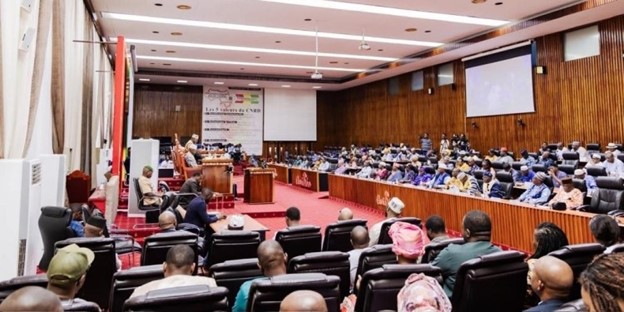
Guinea has taken a significant institutional step toward the long-term development of the Simandou iron ore corridor, as the country’s transitional legislature examined two major draft laws underpinning the Simandou 2040 national development program. The review took place during a plenary session of the National Transitional Council (CNT) on March 5, 2026, marking an important milestone in aligning Guinea’s legislative framework with one of the most ambitious economic transformation strategies in its history.
The legislative package includes a 2026–2040 planning law establishing the long-term framework for the Simandou 2040 program, alongside a 2026–2030 program law that outlines the first implementation phase. Both texts were referred to the CNT’s Committee on Planning, Financial Affairs and Budgetary Oversight, while seven additional parliamentary committees contributed advisory opinions. The plenary agenda was unanimously adopted by council members.
The session gathered several high-level officials, including Prime Minister Bah Oury, Supreme Court First President Mohamed Lamine Bangoura, and Amara Camara, Minister Secretary-General to the Presidency and chair of the Simandou 2040 steering committee, as well as members of the diplomatic corps and senior government representatives.
A Strategic Framework Beyond Mining
Opening the session, CNT President Dr. Dansa Kourouma framed the proposed legislation as a turning point for Guinea’s economic trajectory. According to Kourouma, the Simandou 2040 initiative represents a shift from fragmented development approaches toward long-term strategic planning anchored in resource-driven economic transformation.
While the Simandou project is globally recognized as one of the world’s largest undeveloped high-grade iron ore deposits, Guinean authorities are positioning the Simandou 2040 program as a broader national development platform rather than a purely mining initiative.
The program envisions approximately US$330 billion in investments over a 15-year period, structured around 122 flagship projects and 36 structural reforms designed to reshape the country’s economic architecture.
“Simandou 2040 is far more than a mining project,” Kourouma emphasized during his address. “It reflects a national commitment to transform Guinea’s vast natural resources into shared prosperity, economic stability and sustainable growth.”
Five Pillars for Economic Transformation
The Simandou 2040 framework is built around five strategic pillars intended to diversify and strengthen the national economy:
- Agriculture, agri-industry and trade
- Education and culture
- Infrastructure, transport and technology
- Economy, finance and insurance
- Health and social well-being
These pillars are complemented by a cross-cutting governance and sovereignty framework aimed at reinforcing transparency, institutional accountability and long-term strategic planning.
For mining sector stakeholders, the infrastructure component is particularly significant. The Simandou iron ore development—led by major international consortia—already includes large-scale investments in rail and port infrastructure that are expected to reshape Guinea’s logistics landscape and unlock additional mineral resources across the country.
Aligning Mining Development with National Policy
The legislative review reflects Guinea’s broader policy objective of leveraging large-scale mining projects to drive structural economic transformation. Authorities argue that aligning Simandou’s development with national planning instruments will help maximize local value creation, strengthen industrial capacity and ensure broader socio-economic benefits.
The Simandou 2040 initiative is also framed within the government’s post-2021 state reform agenda under President Mamadi Doumbouya, which seeks to restore public trust in institutions while promoting responsible governance and economic sovereignty.
For the mining industry, the adoption of these laws could provide greater policy clarity around long-term development priorities, infrastructure expansion and economic diversification linked to the Simandou corridor.
If approved, the two legislative instruments would establish the first comprehensive planning framework tying Guinea’s flagship mining project to a coordinated national development strategy—potentially redefining the role of the mining sector as a catalyst for broader economic growth in West Africa’s leading bauxite producer and emerging iron ore powerhouse.