
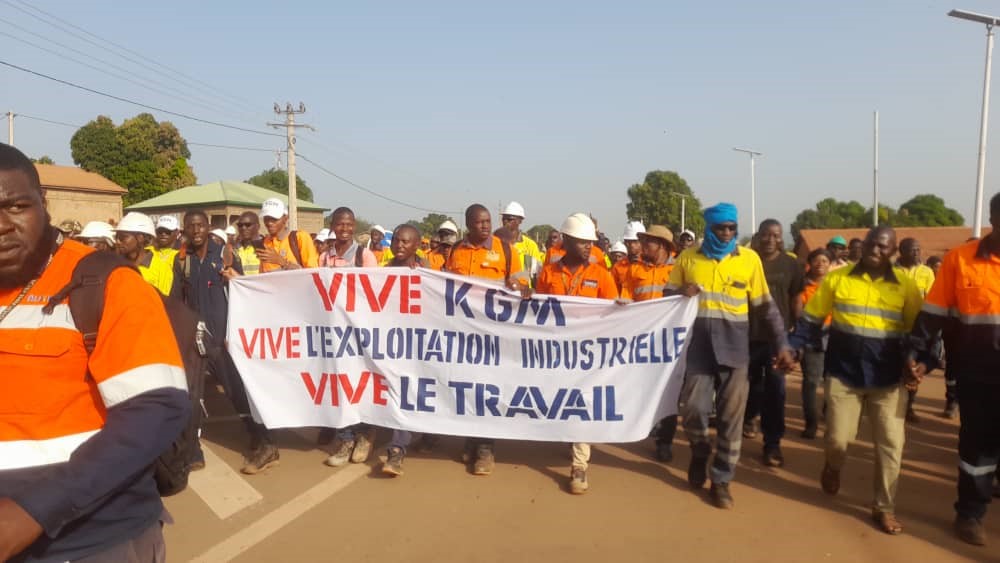
Dozens of employees of Kouroussa Gold Mining (KGM) staged a demonstration in front of the Kouroussa prefecture on Thursday, raising urgent concerns over the growing incursions of artisanal and illegal miners into the company’s active production zones. The workers, who mobilised in significant numbers, voiced fears that persistent illegal mining activities—known locally as orpaillage—are undermining the future of the industrial operation and threatening long-term job security.
Chanting “Our jobs are threatened—down with illegal mining on the project sites,” the protesters demanded decisive intervention from local authorities, whom they accuse of failing to curb the now-recurrent invasions. According to multiple employees, the phenomenon has been ongoing for the past three to four months, with groups of artisanal miners regularly breaching operational areas, forcing the company to halt work and exposing both personnel and contractors to elevated safety risks.
Workers Warn of Potential Site Closure and Job Losses
Speaking on behalf of the workforce, Mohamed Mara, Environmental Officer and President of the KGM workers’ union, highlighted the scale of the disruption.
“Each time these individuals enter the site, operations are stopped, production is halted, and the company loses revenue. Ultimately, it is we, the employees, who risk unemployment,” he stated.
Mara stressed that KGM employees have engaged with authorities on several occasions without seeing a concrete resolution. He denounced what he described as a “culpable silence” from local officials, arguing that inadequate enforcement has emboldened illegal miners.
“If security forces cannot remove these individuals, what conclusion should we draw other than the inaction of the local authorities?” he added.
Security Personnel Report Rising Violence
The escalating tensions have also affected private security contractors tasked with protecting KGM assets.
According to Souleymane Kanté, supervisor of patrol teams at security provider Laguipres, agents are frequently confronted with threats and physical aggression.
“Every day, artisanal miners invade the site. They threaten security officers with pickaxes and other tools. Recently, one of our colleagues had to be rescued after being beaten,” he recounted.
Kanté called on the state to take full responsibility for stabilising the situation:
“If incidents occur, the authorities will be responsible, because they are fully informed of what is happening.”
Authorities Acknowledge the Problem but Struggle for Solutions
Under growing pressure, Kouroussa Prefect Colonel Idrissa Camara met with the demonstrators and admitted that their concerns were legitimate.
“We understand that the workers are here to protect their jobs. As state representatives, we are doing our best to remedy the situation,” he said.
Colonel Camara noted that despite previous emergency meetings and engagement with youth groups in the area, earlier mitigation efforts had failed to deter the artisanal miners. He went as far as describing their persistent incursions as “a form of rebellion.”
In response, he revealed that the prefecture is exploring ways to mobilise around 500 young volunteers to support judicial and security measures aimed at containing the recurring threat.
Sector Analysis: A Test of Social Responsibility and Local Stability
The situation at KGM highlights a growing challenge in Guinea’s gold-producing regions: managing the intersection between industrial mining and artisanal livelihoods. For mining companies, illegal incursions pose not only operational and safety risks but also significant reputational concerns in an era where community engagement and social performance are increasingly scrutinised by investors and regulators.
From a job security perspective, the workers’ fears reflect a genuine economic vulnerability. Production slowdowns directly reduce output, weaken balance sheets, and can trigger cost-cutting measures. If prolonged, disruptions of this scale can threaten the viability of industrial projects—particularly mid-tier operators whose margins depend on stable throughput.
At the same time, corporate social responsibility (CSR) frameworks obligate mining firms to collaborate with local authorities and communities to address the root causes of artisanal encroachment. These include unemployment, land-use disputes, and limited economic alternatives. While enforcement is primarily a state responsibility, companies are expected to invest in community development, livelihood diversification, and inclusive dialogue—strategies that have proven effective in other West African mining jurisdictions.
KGM’s current crisis thus underscores the need for a joint governance model where the state provides security and legal enforcement, while the company strengthens community partnerships and proactive risk management. If left unresolved, tensions between industrial and artisanal miners risk escalating into prolonged conflicts, jeopardising both worker safety and regional stability.
Outlook
As authorities prepare new measures—including mobilising local youth brigades—industry observers will watch closely to see whether these efforts translate into practical improvements on the ground. For the workforce of KGM, the priority remains clear: restoring safe, uninterrupted operations to safeguard the thousands of livelihoods directly or indirectly tied to the project.
If sustainably managed, the Kouroussa case could become a pivotal example of how Guinea’s mining sector navigates the delicate balance between economic development, community expectations, and responsible resource governance.