


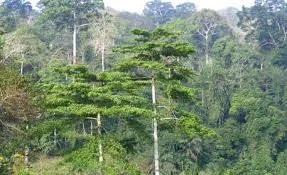
Deep within the classified forests of southeastern Guinea, the Ziama Massif stands as one of West Africa's most significant biodiversity reserves — and one of its most sensitive environmental frontiers. As mining exploration activity continues to expand across the Nzérékoré region, the Ziama Biosphere Reserve presents both a profound conservation obligation and a defining test of the mining sector's commitment to responsible resource governance.
A Reserve of Exceptional Scientific and Ecological Value
Stretching from northeast to southwest across the Guinean forest zone, the Ziama Massif rises to nearly 1,400 metres above sea level, encompassing a complex landscape of valleys, rounded ridges, steep cliff faces, granite outcrops, and elevated plateaus. Its eastern slopes feed the Saint-Paul River, while western drainage flows into the Lofa River — both transboundary watercourses that sustain communities across Guinea and Liberia.
Recognized by UNESCO under its Man and the Biosphere (MAB) Programme since 1980, the Ziama Biosphere Reserve hosts over 1,300 plant species and more than 500 animal species. It is simultaneously a classified forest, a critical bird conservation area, and a last remnant of the Upper Guinean forest formation — one of the world's most threatened tropical ecosystems.
Recent field reporting from within the Sérédou sub-prefecture has further illuminated the reserve's extraordinary layered heritage. Deep in the forest, remnants of Cinchona — the cinchona tree, source of quinine — still stand as silent witnesses to one of colonial-era Africa's most ambitious pharmaceutical ventures. A French colonial experimental station was formally established at Sérédou in 1939 to cultivate cinchona and study its adaptation to Guinean forest conditions. By 1955, a quinine processing facility was operational, briefly positioning Sérédou as one of West Africa's most important pharmaceutical production centres. Today, only scattered trunks remain amid the dense undergrowth — a botanical archive of medical history embedded in the forest floor.
Living Infrastructure: The Strophantus and Ecosystem Function
Equally remarkable is the presence of Strophantus praecox, documented by local eco-guards as the largest liana species within the reserve. This giant climbing plant plays a critical structural role in the forest ecosystem, ascending the tallest canopy trees in pursuit of light and, in doing so, creating biological corridors that allow primates and other arboreal species to move freely through the forest. According to Makim Kolié, an eco-guard stationed within the reserve, the liana's physical architecture constitutes a vital habitat bridge: "Monkeys and small primates use these large lianas to move and live in the forest."
Beyond its ecological function, Strophantus retains documented ethnopharmacological relevance among local communities, who use bark preparations to address chronic abdominal complaints and generalised fatigue — practices that speak to the deep, living relationship between forest communities and the biodiversity surrounding them.
Implications for Mining Operators in the Nzérékoré Region
For mining companies operating or seeking permits in the broader Nzérékoré region, the Ziama Massif presents clear and non-negotiable parameters. The reserve's UNESCO biosphere designation, combined with its national classified forest status, establishes binding constraints on industrial activity in buffer and transition zones. Any operational footprint — whether in exploration, infrastructure development, or logistics corridors — that approaches the Ziama perimeter requires rigorous environmental and social impact assessment, meaningful consultation with forest-edge communities, and the explicit involvement of Guinea's environmental authorities.
The transboundary hydrology of the massif adds an additional dimension of responsibility. Contamination or hydrological disruption affecting the Saint-Paul or Lofa river systems carries potential cross-border consequences, raising the stakes for environmental compliance to an international level.
A Call for Sector Leadership
The Ziama Massif is not merely a regulatory constraint for the mining sector — it is an opportunity. Companies that proactively engage in conservation partnerships, support community eco-guard programmes, and integrate biodiversity offset frameworks into their operational planning will position themselves as credible long-term partners in Guinea's development trajectory.
Guinea's forest patrimony, of which Ziama is a centrepiece, is a shared national asset. The mining sector's social licence to operate in the Nzérékoré region depends, in meaningful part, on its demonstrated willingness to protect it.