

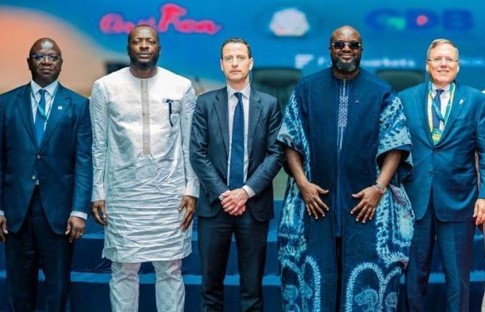
Guinea is seeking to redefine its position in the global mining industry, moving beyond its traditional role as a supplier of raw mineral commodities towards becoming a regional industrial and investment hub. This ambition was at the centre of the inaugural Simandou Mining Summit (SMS), officially launched on November 11, 2026, on Kassa Island, bringing together government officials, mining executives, investors, financial institutions and international partners for four days of high-level discussions, business meetings and investment negotiations.
Held one year after the departure of the first shipment of iron ore from the Simandou project, the summit represents more than an international mining conference. It signals the government's intention to use the momentum generated by Simandou to reshape the country's mining sector, strengthen national participation in strategic projects and accelerate broader economic diversification under the Simandou 2040 development programme.
From Mineral Exports to Industrial Development
The opening of the summit highlighted the scale of Guinea's ambitions. The Simandou project, widely regarded as one of the world's largest integrated mining and infrastructure developments, has established a new foundation for the country's mining logistics. Its approximately 650-kilometre double-track railway and the mineral port at Moribaya in Forécariah Prefecture provide infrastructure that could significantly improve the competitiveness of Guinea's mineral exports.
However, the government's ambition extends beyond transporting larger volumes of minerals to international markets. Speaking during the summit, Presidential Chief of Staff Djiba Diakité stressed that the era of exporting minerals in their raw state must come to an end. He highlighted the importance of local mineral processing, industrial development and value creation within Guinea.
This position reflects a potentially significant shift in the country's mining policy. With the proposed development of an iron and steel plant, alongside ambitions to expand bauxite refining and aluminium production, Guinea is positioning itself to capture a greater share of the mineral value chain.
For mining companies, this evolving policy environment could create opportunities in mineral processing, industrial infrastructure, engineering, equipment supply, logistics, energy and technical services. At the same time, it introduces new expectations regarding local investment, technology transfer and the development of domestic industrial capabilities.
The challenge will be to translate these ambitions into commercially viable projects supported by reliable electricity, competitive transport costs, skilled labour and predictable regulatory frameworks.
A New Model of National Participation in Mining
One of the summit's most important messages concerned the growing role of Guinean companies and professionals in the mining industry.
The performance presented by Nimba Mining Company S.A. (NMC) provided a notable example. According to its Managing Director, Patrice L'Huillier, the company had produced more than eight million tonnes of bauxite at its Tinguilinta mine by November 1, just ten months after its creation. The operation reportedly employs 500 workers and engages 1,500 subcontractors, 98% of whom are Guinean nationals.
Furthermore, more than 85% of the company's procurement of goods and services is reportedly conducted through Guinean companies. NMC aims to reach ten million tonnes of production in 2026 and exceed 14 million tonnes in 2027. Its longer-term ambitions include exploring other minerals and developing an alumina refinery.
These figures illustrate the potential contribution of nationally managed mining enterprises to employment, local procurement and the development of domestic technical expertise.
The government is also emphasising national participation in strategic infrastructure. Djiba Diakité indicated that Guinea holds at least 15% participation in the railway, the ports and the future steel plant associated with the Simandou development framework. This approach seeks to ensure that the country participates not only as the owner of mineral resources but also as a shareholder and decision-maker in the infrastructure supporting their exploitation.
For the wider mining industry, this could encourage a new generation of Guinean mining companies, contractors, engineering firms and specialised service providers. Nevertheless, sustaining this model will require access to financing, strong corporate governance, technical capabilities and the ability to meet international operational standards.
Simandou 2040: An Investment Platform for Economic Diversification
The summit also served as a platform to promote the broader Simandou 2040 programme, presented as a 15-year development framework involving approximately $200 billion in investments, 122 megaprojects, 36 reforms and 14 priority sectors.
The government expects private capital to finance approximately 40% of the programme, making the mobilisation of domestic and international investors a central priority.
Namory Camara, Managing Director of the Guinea Development Board (GDB), emphasised the importance of creating an environment in which the next industrial facility, service company and generation of entrepreneurs can prosper. He highlighted the need for reliable energy, suitable industrial sites, competitive transportation and access to new markets.
His message reflects an important economic reality: mining infrastructure alone cannot deliver sustainable development. Its wider economic impact will depend on how effectively it supports other sectors, particularly agriculture, manufacturing, construction, transport and services.
The railway and port infrastructure developed under Simandou could become strategic assets for multiple industries, provided that access arrangements, tariffs and operational capacity allow broader economic use.
The summit's planned programme of more than 3,000 business meetings and participation by over 2,000 delegates demonstrates the government's intention to convert international interest into concrete investment commitments.
For investors, the Guinea Development Board's proposed role as a central point of contact could also help improve project coordination and facilitate engagement with public institutions.
What Does This Mean for the Guinean Population?
Ultimately, the success of the Simandou Mining Summit should be measured not only by investment announcements or mineral production figures, but by its contribution to the living standards of ordinary Guineans.
Employment creation is an immediate priority, particularly for the country's large and growing youth population. The government's emphasis on local content, technical training and the Simandou Academy could help develop the engineers, geologists, mining technicians, railway operators and industrial specialists required by an expanding economy.
Women and young entrepreneurs could also benefit from new opportunities in mining supply chains, construction, logistics, catering, environmental services and professional consulting.
Agriculture presents another important opportunity. Improved transportation infrastructure could facilitate the movement of agricultural products, reduce logistical constraints and connect producers to larger domestic and international markets. Similarly, industrial development could generate demand for local agricultural products, creating stronger links between mining and rural economies.
However, these benefits will not materialise automatically. Local companies must be equipped to compete for contracts, training programmes must respond to actual industry requirements, and employment opportunities must extend beyond a limited number of highly specialised positions.
There is also a need to ensure that mining expansion is accompanied by effective environmental management, responsible land acquisition, community consultation and transparent compensation mechanisms.
Investor Confidence and the Test of Implementation
President Mamadi Doumbouya used the summit to deliver a firm message concerning national sovereignty and compliance with Guinean laws. His declaration that the country would no longer tolerate exceptions in the enforcement of rules signals a more assertive approach to managing relationships with mining investors and international partners.
At the same time, he reaffirmed Guinea's openness to international investment, emphasising partnership, shared risks, technology transfer and respect for contractual commitments.
This balance will be critical. Investors require regulatory predictability, transparent decision-making, effective dispute-resolution mechanisms and confidence that agreements will be implemented consistently. Guinea, in turn, expects investors to respect national legislation, deliver their commitments and contribute meaningfully to local economic development.
The President also highlighted the intention to direct a substantial portion of Simandou-generated revenues towards a sovereign fund for future generations. If supported by sound governance, transparency and prudent investment management, such a mechanism could help transform finite mineral resources into long-term national wealth.
Beyond the Summit: Delivering Measurable Results
The inaugural Simandou Mining Summit marks an important moment in Guinea's mining development trajectory. It brings together several priorities that have increasingly shaped the country's economic ambitions: greater national participation, local mineral processing, infrastructure sharing, private investment, skills development and economic diversification.
Yet the real significance of the summit will depend on what happens after the delegates leave Conakry.
The next phase must translate discussions into bankable projects, financing agreements, industrial facilities, procurement contracts, employment opportunities and measurable improvements in the business environment.
For Guinea's mining industry, the opportunity is considerable. The country possesses substantial mineral resources, expanding infrastructure and growing international visibility. The challenge is to ensure that these advantages create a competitive and diversified economy rather than simply increasing the volume of raw mineral exports.
The Simandou Mining Summit has presented Guinea's ambition to become more than a major mining destination: it wants to become a country where minerals generate industries, infrastructure creates opportunities, and national participation builds lasting prosperity. Whether this ambition becomes reality will ultimately be determined by implementation, institutional capacity and the tangible benefits delivered to the Guinean population.
Share on social media

-