


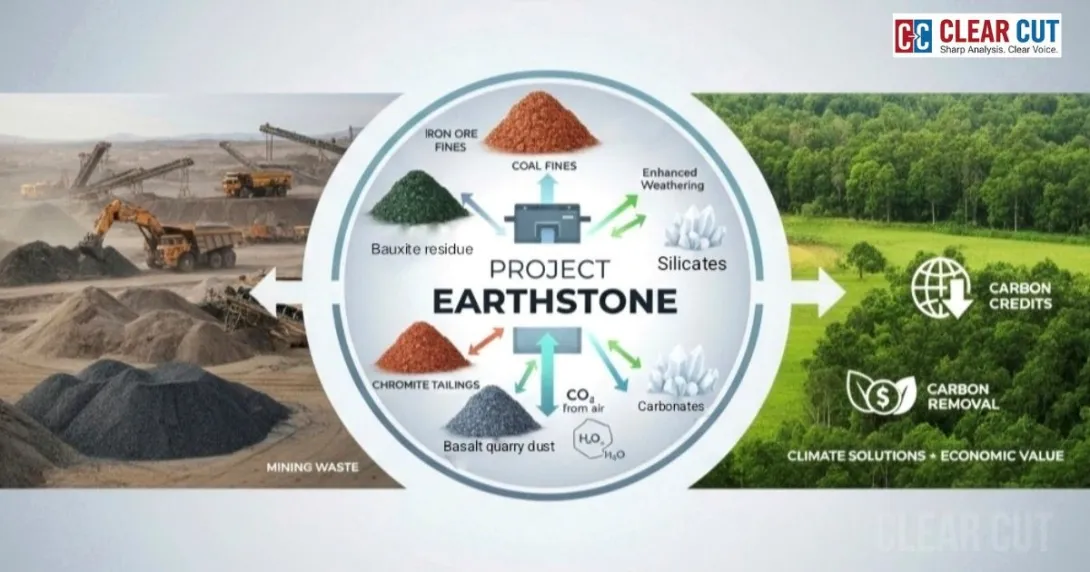
On September 23rd, 2025, Project Earthstone was launched in Brazil—a landmark collaboration between Isometric (a carbon removal standards and registry organization), Anglo American (a leading global mining company), and ZeroEx (a German Enhanced Weathering specialist). The project’s goal is to revolutionize the mining sector by transforming mine waste into large-scale, permanent carbon stores through Enhanced Weathering (EW), an innovative climate technology.
Mining produces millions of tonnes of by-products—tailings, residues, and overburden—often treated as waste. Yet many of these materials contain silicate minerals, which naturally capture carbon dioxide when they react with air and water. By grinding them into fine powder and exposing them to moisture, this reaction can be accelerated, forming stable carbonates that lock up CO₂ for millennia. Project Earthstone aims to show that this can be done safely, verifiably, and profitably at scale.
Guinea’s Mining Landscape: A Hidden Climate Opportunity
Guinea, often referred to as the “geological scandal” of West Africa, holds immense mineral wealth. The country is the world’s second-largest bauxite producer, a major source of gold and diamonds, and is set to become a key iron ore exporter with the long-awaited Simandou project. These industries generate vast quantities of waste—bauxite residue (red mud), iron ore tailings, lateritic overburden, and mine dust—that are both an environmental challenge and an untapped opportunity.
Under an Enhanced Weathering framework, many of these materials could serve as powerful carbon capture resources. Guinea’s geological formations — particularly in Boké, Kindia, Siguiri, and Kérouané — contain silicate-rich rocks such as basalt, serpentine, and olivine, all of which react readily with CO₂. When processed and spread on land or mixed into soils, these by-products could permanently store carbon while also neutralizing acidic soils and improving agricultural productivity—a potential co-benefit for rural communities.
Transforming Mine Waste into Carbon Storehouses
Mining in Guinea generates hundreds of millions of tonnes of waste annually. The bauxite sector alone, led by companies like CBG (Compagnie des Bauxites de Guinée) and SMB-Winning Consortium, produces millions of tonnes of red mud—a fine, caustic by-product of alumina refining. Similarly, future iron ore operations in Simandou will yield large volumes of tailings and silicate-rich overburden. Instead of stockpiling or disposing of these materials, Enhanced Weathering could convert them into carbon sinks, turning liabilities into environmental assets.
The advantage lies in the fact that these materials are already mined, transported, and processed—significantly reducing additional costs. This makes Enhanced Weathering a low-hanging fruit for Guinea’s mining industry and a potential entry point for climate innovation and green investment.
Building a Carbon Market for Guinea
The success of Project Earthstone in Brazil relies not just on technology but also on a carbon credit ecosystem that rewards verified carbon removals. Guinea could follow this path by developing or integrating into international voluntary carbon markets. Verified Enhanced Weathering projects could generate carbon credits valued between $10–$40 per tonne of CO₂ removed, depending on quality and verification standards.
Such credits could attract foreign climate finance, enabling mining companies to offset operational emissions while generating new revenue streams. Partnerships with global organizations—such as Isometric, Verra, or Gold Standard—could provide Guinea with transparent measurement and verification frameworks to certify EW-based carbon removals.
Challenges and the Way Forward
Replicating Project Earthstone in Guinea will require overcoming several hurdles: the need for scientific research on local mineral reactivity, infrastructure for material grinding and spreading, regulatory frameworks to integrate EW into climate policies, and verification capacity for carbon accounting. There will also be a need for collaboration between government, mining companies, and academia to ensure environmental safety and public acceptance.
However, the potential rewards are transformative. Enhanced Weathering could help Guinea:
- Reduce the carbon footprint of its mining operations.
- Generate exportable carbon credits for international markets.
- Create green jobs and stimulate research in sustainable mining.
- Turn mining waste into an asset that supports national climate goals.
A Model for Africa’s Green Mining Transition
Guinea’s combination of mineral abundance, tropical weather that accelerates natural weathering, and emerging environmental awareness positions it as an ideal testbed for Earthstone-style projects in Africa. If Guinea’s mining leaders—CBG, SMB-Winning, Rio Tinto Simfer, and others—embrace this opportunity, the country could pioneer Africa’s first large-scale Enhanced Weathering program, transforming its mining legacy into a climate solution.
Project Earthstone represents more than technological innovation; it symbolizes a new way of thinking about mining waste. For Guinea, replicating it could mean turning its vast mineral by-products into enduring carbon storehouses—helping the nation move from a raw materials exporter to a climate technology leader in West Africa.