


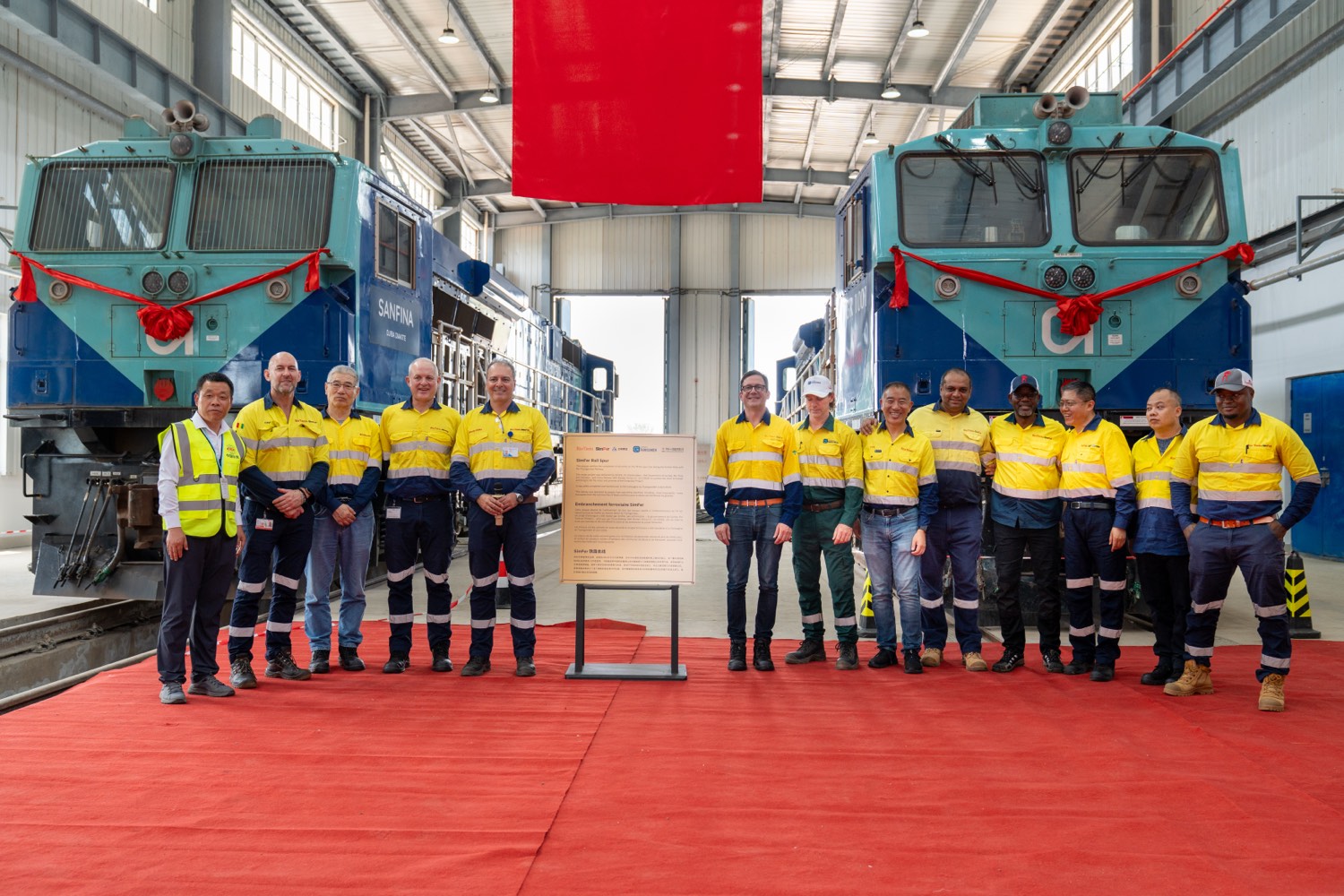
Conakry, Guinea — SimFer, the joint venture involving the Government of Guinea, Rio Tinto and the CIOH consortium led by Chinalco, has announced the completion of construction works on the 70-kilometre railway spur linking the SimFer mine to the Trans-Guinean Railway, a development expected to accelerate the operational readiness of the Simandou iron ore project.
The milestone represents a critical advancement in the integrated logistics system underpinning Simandou, one of the world’s largest undeveloped high-grade iron ore deposits. Although train movements on the line began in November, the recent ceremony formally recognized completion of construction and delivery of the infrastructure package.
Developed in partnership with China Railway 18th Bureau Group Co. Ltd (CR18), the railway connection is designed to support the progressive ramp-up of iron ore shipments from SimFer’s mining operations to export markets. The infrastructure is expected to play a decisive role in reducing transport bottlenecks and enabling commercial-scale production.
Infrastructure Delivery Signals Execution Capacity
Beyond the headline figure of a 70 km connection, the project involved construction of substantial supporting infrastructure, including:
- 146 km of railway track installed
- Five railway bridges totaling approximately 1.75 km
- A 926-metre railway tunnel
- Passenger station facilities
- 210 km of fibre optic network deployment
- Integrated signalling, telecommunications and asset protection systems
The scope highlights the complexity of delivering mining infrastructure in Guinea’s southeastern terrain, where logistics challenges, topography and seasonal conditions have historically affected project schedules.
Completion on schedule and within budget sends an important signal to investors following years of scrutiny around the pace and governance of Simandou’s development. Large-scale mining infrastructure projects in West Africa frequently face delays linked to financing, permitting, engineering constraints and community relations.
Safety Performance Emerges as Key Achievement
Project leaders emphasized safety as one of the most notable outcomes.
According to Mark Davies, Chief, Safety and Technical Services at Rio Tinto, construction teams accumulated nearly 15 million working hours without a lost-time injury (LTI) — a performance metric considered exceptional for heavy civil and rail construction projects of this scale.
The achievement reflects increasing emphasis among major mining operators on embedding international safety standards into African infrastructure developments, particularly where multinational workforces and contractors are involved.
Construction reportedly mobilized teams from more than 30 countries, underscoring the international character of the Simandou supply chain.
Local Workforce Participation Gains Attention
Company representatives also highlighted the contribution of Guinean employees, including workers from Beyla and Kérouané prefectures located near project areas.
Local employment and skills transfer remain politically and economically significant issues in Guinea’s mining sector, where stakeholders increasingly expect projects to generate lasting domestic capabilities beyond royalty payments and export revenues.
Chinalco Vice President Dong Jianxiong stated that continued investment in technical and managerial training for local talent would remain a priority alongside community development initiatives.
Strategic Implications for Guinea’s Mining Sector
The completion of the railway spur extends beyond a single infrastructure milestone. It demonstrates tangible progress toward operationalizing the broader Simandou corridor — a project widely viewed as transformative for Guinea’s mining economy.
Once fully operational, Simandou is expected to reshape Guinea’s position in the global iron ore market, diversify export revenues beyond bauxite, and stimulate secondary economic activity through logistics, services and industrial development.
However, the long-term impact will ultimately depend on sustained execution, efficient commissioning of remaining infrastructure, and the project’s ability to translate construction achievements into stable commercial production.
For Guinea’s mining industry, the message is clear: Simandou is steadily moving from ambition toward delivery.