


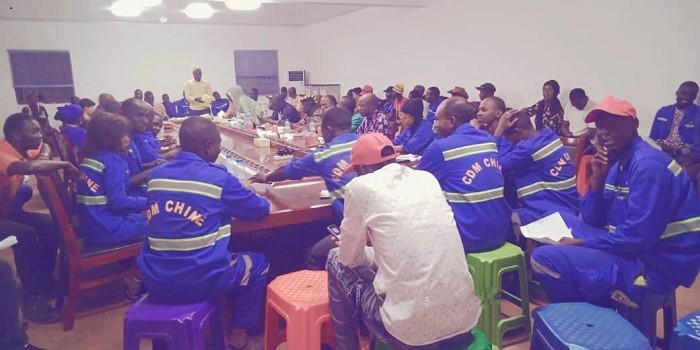
Negotiations between workers and management at CDM-China have reached an impasse, prompting the company's trade union collective to seek intervention from Guinea's national labor federations, UGTG and USTG, as a strike deadline looms within 48 hours.
The dispute, which has been simmering since a strike notice was filed on September 25, 2025, has drawn the attention of prefectural authorities from both Telimélé and Boké, though their mediation efforts have failed to produce a resolution. The situation underscores growing labor tensions in Guinea's critical mining sector, which remains a cornerstone of the nation's economy.
In a letter dated October 8, 2025, union secretary general Mamady Diakité detailed a breakdown in negotiations that occurred during talks facilitated by the two prefects. According to the correspondence, authorities requested workers postpone strike action until after December's presidential election, offering no concrete agreements on workers' demands.
The union representatives allege the mediation session deteriorated into intimidation and threats. "Labor inspectors present drafted a protocol agreement, and the prefects ordered us to sign it or face consequences," the letter states. When union leaders refused to sign without consulting their membership and national federations, they claim they were detained by security forces.
Under duress, the workers' representatives reportedly signed a handwritten commitment to suspend strike action. However, the union collective has since declared this agreement "null and void," stating it was signed under coercion rather than voluntarily.
The Telimélé prefect had previously promised to address workers' grievances following the recent constitutional referendum results. That intervention materialized on October 8, but rather than resolving disputes, it appears to have deepened the crisis.
Implications for Guinea's Mining Sector
The standoff at CDM-China reflects broader challenges facing Guinea's mining industry, which has attracted substantial Chinese investment in recent years. Labor relations remain a persistent concern as international operators navigate Guinea's regulatory environment and workforce expectations.
The involvement of Guinea's two major trade union confederations—UGTG (Union Générale des Travailleurs de Guinée) and USTG (Union Syndicale des Travailleurs de Guinée)—signals potential escalation. These national federations wield considerable influence and could coordinate broader labor action across multiple mining operations if the dispute remains unresolved.
Mining companies operating in Guinea are closely monitoring developments at CDM-China, as the outcome could establish precedents for labor negotiations sector-wide. With Guinea positioning itself as a major bauxite producer and seeking to develop its iron ore potential, labor stability is essential for maintaining investor confidence.
The timing is particularly sensitive, coinciding with Guinea's electoral calendar. Authorities' apparent strategy of delaying substantive negotiations until after December's presidential election may reflect concerns about political stability, but risks prolonging industrial uncertainty.
As the original strike deadline expires, attention now turns to whether UGTG and USTG intervention can break the deadlock. The unions face pressure to demonstrate effectiveness in protecting workers' rights while avoiding disruption to an industry vital to Guinea's economic development.
CDM-China management has not issued public statements regarding the negotiations. The company's response to the unions' appeal for national federation involvement will likely determine whether this dispute resolves peacefully or escalates into broader industrial action affecting Guinea's mining sector.