


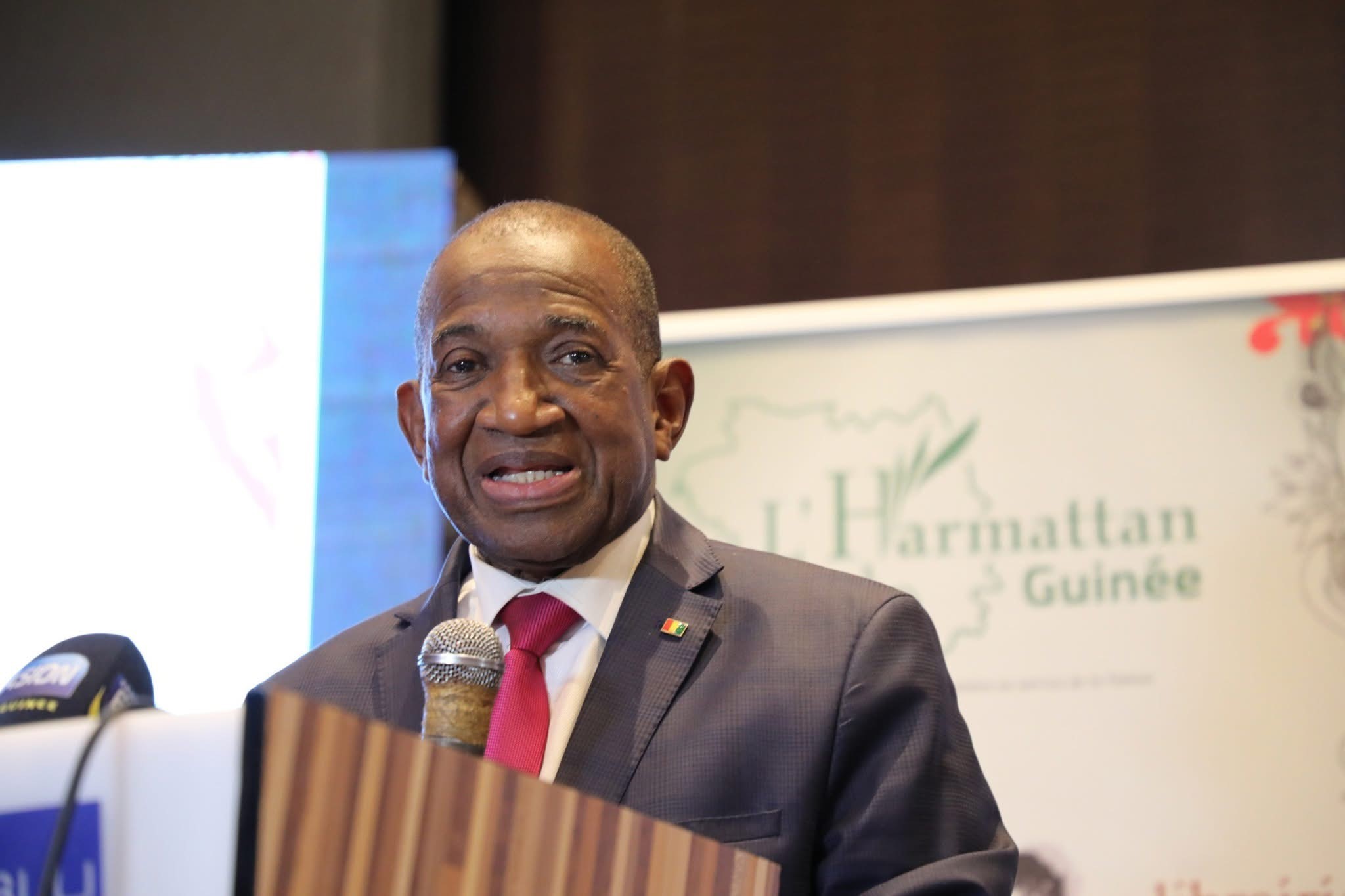
As Guinea prepares for one of the most ambitious mining developments in its history, the Simandou iron ore project continues to draw national and international scrutiny. In a recent interview with RFI, former Prime Minister Kabiné Komara delivered a strong and timely warning: without full enforcement of environmental commitments, Simandou could repeat—on a larger scale—the ecological degradation witnessed in the country’s bauxite corridors.
Komara, an experienced statesman and a respected environmental advocate, has long observed what he calls a “rapid and alarming decline” of Guinea’s biodiversity. His latest concerns come as the Simandou project—led by Rio Tinto and Winning Consortium Simandou (WCS)—enters a decisive implementation phase, involving open-pit mining, a 650-kilometre cross-country railway, and a deep-water export port on the Atlantic coast.
A Record of Degradation That Cannot Be Repeated
Guinea’s mining sector, particularly bauxite extraction in Boké and Kindia, has left visible scars: deforestation, soil loss, dust pollution, and the destruction of farmland. Komara recalls how open-pit operations required stripping of topsoil, blasting of pits, and extensive land clearing, leaving “gaping holes” that led to water shortages, community displacement, and rising health issues.
His alarm echoes the concerns of communities and NGOs who fear that Simandou, with its massive footprint across four natural regions, may follow a similar trajectory if environmental safeguards are not rigorously applied.
Simandou: A Project with High Stakes for Biodiversity
The Simandou corridor runs from the forested southeast to the coastal west—crossing fragile ecosystems, river basins, agricultural zones, and protected habitats. Komara acknowledges that the environmental reviews for Simandou have been more detailed than for any previous mining project in Guinea. The government, Rio Tinto, and WCS have conducted extensive impact assessments, and a multi-stakeholder monitoring committee has been set up to oversee compliance.
However, the former Prime Minister stresses that the real challenge is not planning, but enforcement. Guinea, he notes, “has many laws but few implementing decrees.” The gap between legislation and execution remains a chronic issue, particularly in mining governance.
He warns that any deviation from agreed-upon standards—whether in land acquisition, water management, or biodiversity protection—could have irreversible consequences. Already, civil society groups such as Action Mines Guinée have reported cases of farmland loss and water contamination along portions of the railway route, raising questions about mitigation measures on the ground.
Transparency and Governance Under the Spotlight
One of Komara’s most striking revelations concerns the long-debated transparency of the Simandou agreements. Contrary to public belief, he states that key project documents have been transmitted to the IMF and the World Bank—an important step toward better governance. This disclosure, although not equivalent to full public release, suggests increased pressure from international lenders for clearer project oversight.
Still, stakeholders argue that publishing the mining convention remains essential to build public trust—especially in a context where land acquisition, compensation, and environmental management have historically been areas of tension between mining companies and communities.
Environmental and Social Responsibility: A Critical Test for Operators
Komara highlights that both Rio Tinto and WCS have agreed to align their operations under Rio Tinto’s stricter environmental standards—an alignment many observers view as a major achievement, given the long-standing concerns over inconsistent compliance among operators in Guinea.
Notably, the consortium has already begun developing a seed bank to preserve local plant species, aiming to support future site rehabilitation—an important step but only one component of a much broader set of commitments required for responsible mining.
For mining companies, Simandou is more than a commercial venture; it is a test of long-term sustainability. Ensuring job security, community acceptance, and investor confidence requires robust environmental risk management. Experience shows that ecological damage leads to social conflict, operational disruptions, and reputational risks—factors that can derail even the most strategic mining investments.
A Call for National Mobilization and Rigorous Enforcement
Beyond the project itself, Komara points to wider environmental degradation driven by population pressure, uncontrolled agricultural expansion, and destructive artisanal gold mining using mercury and cyanide. These cumulative pressures make Guinea’s ecosystems more vulnerable and increase the responsibility placed on large industrial operators to adopt best-in-class environmental practices.
His message is clear: Guinea cannot afford another cycle of mining-induced degradation. The country must transform environmental pledges into enforceable regulations, monitored transparently and applied consistently to all operators.
Conclusion: A Defining Moment for Guinea’s Mining Future
Simandou represents a generational opportunity—one that could redefine Guinea’s economic landscape. But as Komara warns, it is also a defining test of the country’s ability to balance development with ecological protection.
For mining actors—operators, regulators, and investors—the coming months will be critical. Environmental responsibility, transparent governance, and community engagement will determine not only the success of Simandou, but also the future credibility of Guinea’s mining sector.
In an era where global markets increasingly reward sustainability, Guinea must ensure that Simandou becomes an example of responsible mining—not a repeat of past mistakes.