


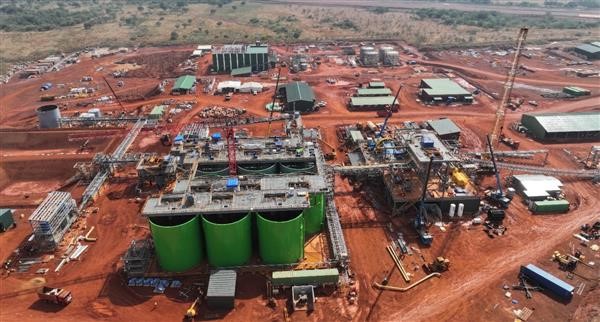
Guinea's gold mining sector has reached a pivotal milestone with Robex Resources Inc. (TSX-V:RBX, ASX:RXR) successfully delivering first ore to the processing plant at its Kiniéro gold project, positioning the operation for first gold pour this month and commercial production in Q1 2026.
The development marks a significant step in Guinea's ongoing efforts to diversify its mining sector beyond bauxite, which currently dominates the country's mineral exports. While Guinea remains a mid-tier gold producer in West Africa—trailing established leaders such as Ghana, Mali, and Burkina Faso—projects like Kiniéro demonstrate the nation's untapped potential in precious metals production.
Project Economics and Production Profile
Kiniéro presents compelling economics for the West African operating environment. The project's technical studies project annual production of approximately 139,000 ounces over a 9.5-year mine life, with enhanced output averaging 154,000 ounces annually during the first six years. Total life-of-mine production is estimated at 1.2 million ounces, supported by proven and probable reserves of 968,000 ounces and indicated resources of 1.48 million ounces.
Critically, all-in sustaining costs are projected at US$1,066 per ounce—a competitive figure in today's cost-inflated mining environment—with initial capital expenditure estimated at just $160 million. This relatively modest capex, combined with the project's rapid development timeline, positions Robex favorably for near-term cash generation.
The operation features a modern 5-million-tonne-per-annum processing facility with design flexibility to handle higher throughput rates during early production phases, depending on ore blend optimization. This operational flexibility will be crucial for maximizing returns during the higher-grade early years.
Strategic Implications
Robex's transition from developer to producer represents a strategic inflection point for the company's West African portfolio, which includes the established Nampala operation in Mali (230,000 ounces produced since 2017). CEO Matthew Wilcox's stated ambition to establish Robex as "West Africa's next mid-tier gold producer" appears increasingly viable as Kiniéro moves toward steady-state operations.
The successful commissioning—with mechanical, electrical, and instrumentation systems performing to design specifications—reflects competent project execution in a jurisdiction where infrastructure and logistics remain key operational challenges. Guinea's mining operators consistently cite power supply reliability, transport corridors, and permitting timelines as material considerations for project development.
Sector Context and Outlook
Guinea's gold sector comprises both industrial production, led by AngloGold Ashanti's Siguiri operation, and substantial artisanal mining activity, which accounts for a significant portion of national gold exports. This dual structure presents both opportunities and complexities for formal sector operators.
Kiniéro's 470-square-kilometer land package offers considerable exploration upside, with numerous identified targets for potential resource expansion at depth and along lateral extensions. This exploration potential could extend mine life and production volumes beyond current reserve estimates, a critical factor for sustaining investor interest and operational returns.
As Guinea seeks to leverage its mineral endowment for economic development while managing the balance between bauxite dominance and sectoral diversification, projects like Kiniéro will serve as important test cases for attracting additional gold-focused investment capital to the jurisdiction.
The coming weeks will be critical as Robex progresses through commissioning toward maiden production, with market participants closely monitoring ramp-up performance and early production metrics.