


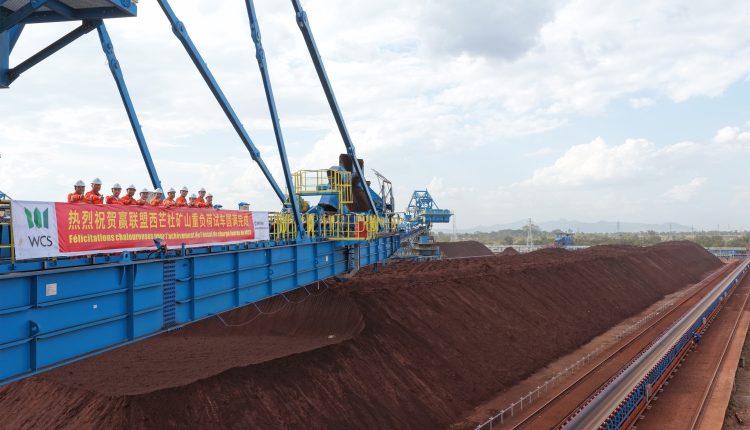
Guinea’s flagship iron ore development, the Simandou mega-project, has reached another major technical milestone as operators finalize preparations for the official operations launch scheduled for 11 November. Baowu Resources West Africa, one of the project’s core industrial partners, confirmed the successful completion of iron ore load testing—an achievement that strengthens confidence in the project’s commissioning timeline and long-term production strategy.
According to Baowu, the load testing phase ran for a continuous 120 hours, validating the mechanical reliability and operational readiness of the production line. Significantly, on 4 November the system achieved its nominal design capacity of 90,000 tonnes per day per line, demonstrating that the infrastructure is capable of meeting its planned output parameters under real operating conditions.
For a project that has faced years of global scrutiny, delays, and complex negotiations, the successful execution of this technical step sends a strong signal to mining companies, investors, and supply-chain partners. It indicates that Simandou’s operators are now transitioning from construction to operational ramp-up—a phase that will reshape Guinea’s mining landscape and global iron ore supply dynamics.
Baowu’s management commended the operational teams on-site, highlighting what it called a “remarkable performance” delivered despite “numerous challenges.” The company emphasized the high level of engineering control demonstrated throughout the test run, attributing the outcome to robust project management and extensive coordination among the consortium’s industrial partners.
A Turning Point for Guinea’s Iron Ore Ambitions
Simandou is widely regarded as one of the most significant iron ore deposits globally, with high-grade reserves capable of influencing supply flows to steelmakers across Asia, Europe, and the Middle East. The successful testing marks a turning point for a project that has been under development for more than a decade, following multiple ownership changes, logistical negotiations, and national infrastructure commitments.
The consortium’s ability to deliver the testing phase within schedule is also viewed as an encouraging indication of operational discipline. Baowu reiterated that the project’s ramp-up calendar will be “fully respected, as was the case during the construction period,” reaffirming investor confidence that Simandou may avoid the delays typically associated with mega-projects in the mining sector.
For mining companies operating in Guinea or considering entry into the market, Simandou’s progress reinforces several key trends:
- Acceleration of Infrastructure Integration:
The operationalization of Simandou will bring substantial improvements to multi-user rail and port infrastructure in the southeast corridor. Companies in bauxite, gold, and specialty minerals should expect broader logistics synergies as the corridor matures. - Increased Competition for Skilled Labor:
As Simandou enters its production phase, demand for specialized mining and rail talent will increase. Operators in Guinea may need to adjust workforce strategies, strengthen training pipelines, and enhance retention incentives. - Environmental and Social Performance Expectations:
Given the project’s global visibility, ESG standards are under heightened scrutiny. Other mining entities in Guinea should anticipate tighter regulatory expectations and growing pressure to demonstrate compliance with international best practices. - Shift in Global Iron Ore Markets:
With Simandou’s high-grade ore expected to flow to international steel mills, global supply chains—particularly in Asia—may experience pricing and sourcing realignments. This could create both risks and opportunities for producers and traders.
A Strategic Milestone With Long-Term Implications
The successful load test consolidates Simandou’s position as Guinea’s most transformative mining development to date. For the Guinean government, it signals approaching revenue flows, stronger infrastructure assets, and enhanced global mining visibility. For Baowu and its partners, it validates years of technical planning and capital deployment.
As the official launch ceremony approaches, mining actors will be watching closely. With ramp-up now underway, Simandou is not just a project milestone—it is the beginning of a new chapter for Guinea’s extractive sector and a potential game-changer in global iron ore markets.