


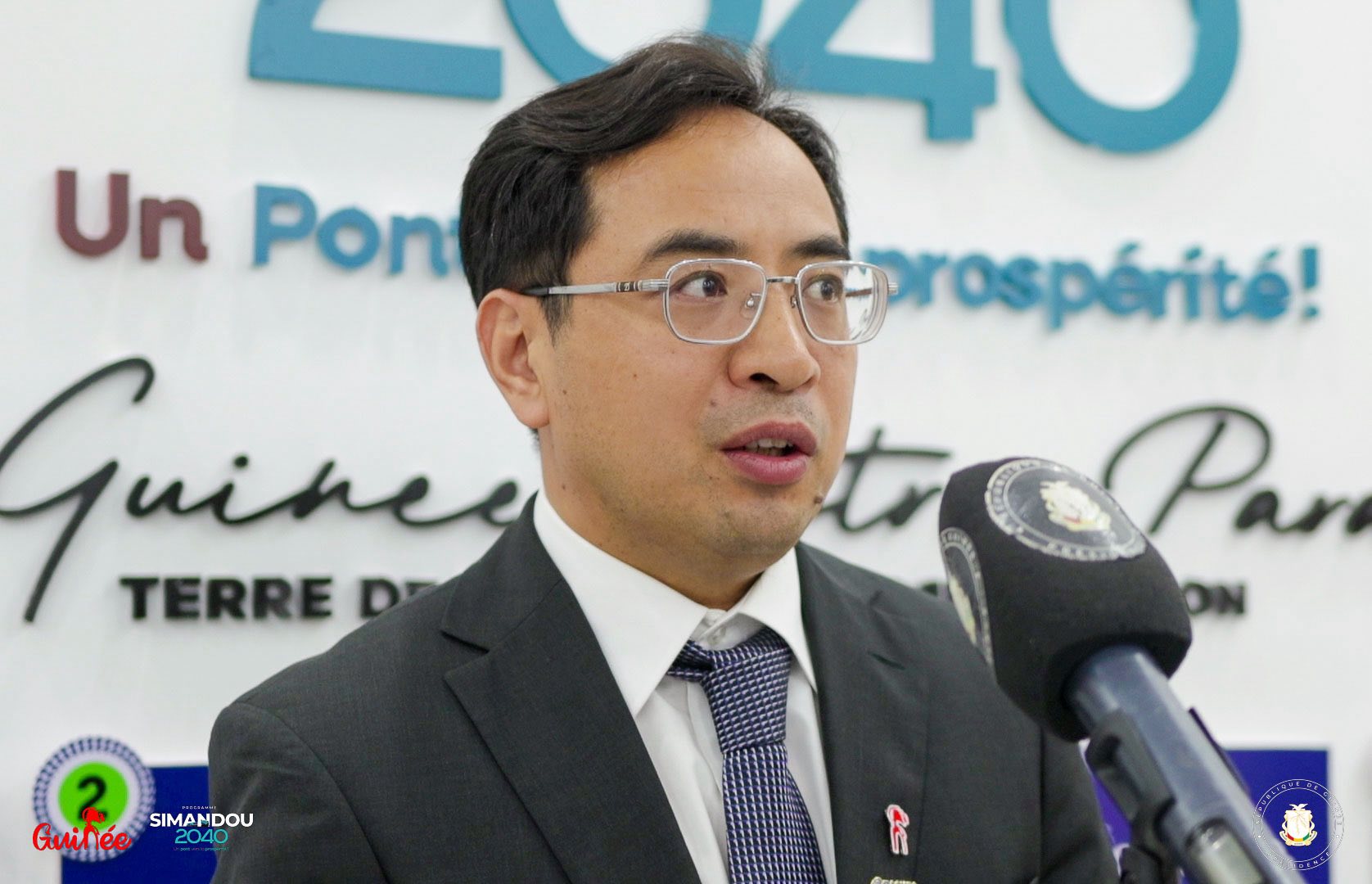
An Analysis of Baowu Resources West Africa’s September Interview with Guineenews
The Simandou Iron Ore Project—long described as Guinea’s “project of the century”—is entering a decisive phase. As 2025 approaches, expectations are intensifying among Guinean authorities, investors, and local communities. In this context, the interview granted in September by Jiang Gongyang, Vice President of Baowu Resources and Deputy Executive General Manager of Baowu Resources West Africa (BRWA), offers rare insight into the mindset, ambitions, and strategic posture of the Chinese steel giant within the multi-billion-dollar undertaking.
China Baowu, now the world’s largest steelmaker with annual production of 130 million tonnes, occupies a central position in the Simandou consortium structure—partnering with Winning Consortium Simandou (WCS) on Blocks 1 and 2, and co-developing Blocks 3 and 4 with Rio Tinto and Chinalco. The vice president’s remarks thus shed light not only on Baowu’s operational progress, but also on the broader industrial and geopolitical implications of Simandou for Guinea and global steel supply chains.
This analysis examines the underlying messages conveyed in the interview, assesses the current trajectory of the project, and highlights both the transformative opportunities and emerging risks that Guinea must carefully manage as Simandou moves closer to production.
1. A Rare Confirmation: Infrastructure 80% Complete and 2025 Exports Still in Sight
Perhaps the most significant takeaway from Jiang Gongyang’s interview is the confirmation that—by early September—the mine, rail, and port package had reached an average completion rate above 80%. Given the scale of works being undertaken—nearly 600 kilometers of heavy-haul rail, a deep-water export terminal, and two massive mining complexes—this figure is remarkable.
It also reinforces the assertion that the first export of Guinean iron ore from Simandou remains scheduled for the end of 2025.
For Guinean authorities, this is a critical benchmark. The country has waited decades for tangible progress on Simandou. Past delays, legal disputes, and global market fluctuations created widespread skepticism. However, the alignment of interests between Rio Tinto, Baowu, WCS, and the Guinean government—coupled with China’s strategic need for high-grade ore—has accelerated execution at a pace rarely seen in West African infrastructure megaprojects.
Nevertheless, this optimism must be balanced against operational realities. Guinea is currently experiencing political, fiscal, and logistical pressures linked to the country’s ongoing transition period. Heavy rainfall, landslides, mountainous engineering challenges, and the enormous coordination required across multiple contractors and shareholders could still affect timelines. But the message conveyed by BRWA’s leadership is clear: the consortium remains mobilized and confident.
2. Baowu’s Strategic Positioning: Beyond Mining, an Anchor for Global Steel Decarbonization
Jiang’s statements reiterate that Baowu’s involvement in Simandou is not merely a resource acquisition strategy. Instead, it forms part of a global steel decarbonization agenda. High-grade Simandou ore—typically above 65% Fe—is increasingly indispensable for producing low-carbon steel through advanced technologies such as:
- Direct Reduced Iron (DRI) using hydrogen
- Electric Arc Furnaces (EAF)
- High-efficiency blast furnaces with lower emissions
The VP’s confirmation that Baowu is exploring a pellet plant in Guinea is particularly important. Pelletization would:
- increase local value addition
- create skilled jobs
- reduce transport of low-value fines
- support global demand for green-steel feedstock
- position Guinea as a processing hub, not just an exporter of raw ore
This aligns with national objectives under the Guinean Mining Code and the government’s broader industrialization agenda.
For Guinea, the presence of Baowu—the world’s most influential steel company—provides long-term stability for off-take, financing, and technical expertise. However, it also embeds Guinea deeper into China’s global industrial network, a dynamic that must be managed so that national sovereignty, local content, and equitable benefit sharing remain firmly protected.
3. Economic Transformation: Massive Potential, Uneven Risks
The BRWA executive highlights the US$20 billion value of the overall Simandou infrastructure and mining package, making it the largest industrial investment in Guinean history. The magnitude of this investment provides multiple potential benefits:
Positive Impacts
- Modernization of national logistics through a trans-Guinean rail corridor
- Creation of tens of thousands of jobs, both direct and indirect
- Expansion of local enterprises, subcontractors, and services
- Boost in fiscal revenue, royalties, and foreign exchange
- Acceleration of regional development, especially in forested Guinea and the southeast
- Strengthening Guinea’s position as a top-tier global mining jurisdiction
If managed effectively, Simandou can fundamentally reshape Guinea’s economic trajectory—much like iron ore did for Australia and Brazil.
But significant risks remain
Despite the strong progress, Guinea must remain vigilant about several strategic vulnerabilities:
- Over-dependence on a single commodity
Revenues from iron ore can fluctuate sharply with global prices. - Potential land, livelihood, and resettlement conflicts
Large-scale infrastructure projects inevitably reshape communities. - Environmental pressures on biodiversity-rich zones, particularly in Simandou’s mountainous ecosystems.
- Fiscal risks if global iron ore prices fall or if project costs escalate.
- Governance risks linked to transparency, procurement, and monitoring of local content obligations.
The interview briefly mentions community initiatives and social programs, but Guinea must ensure these commitments translate into long-term, measurable improvements for directly affected populations—from Beyla and Kérouané to Forécariah and the wider project corridor.
4. A New Regional Strategy: Baowu Expands Beyond Guinea
One lesser-discussed point in the interview is Baowu’s broader footprint in West Africa, including:
- operational production at Bomi, Liberia
- feasibility studies at Lobi, Cameroon
This signals a long-term China-led strategy to diversify iron ore supply outside the traditional giants (Australia and Brazil). While this enhances regional integration and offers new investment opportunities, it also increases strategic competition among African producers.
Guinea must ensure that Simandou remains the flagship project within this regional portfolio and that downstream opportunities—pellets, hot-briquetted iron, steel production—are developed inside Guinea rather than relocated elsewhere.
5. Governance and National Vision: The Need for Strong State Stewardship
Jiang Gongyang emphasizes Simandou’s “historic and transformative” nature. This assessment is accurate. But history shows that mega-projects can fail to deliver broad-based prosperity without:
- rigorous state oversight
- transparent revenue management
- strong local content enforcement
- long-term environmental stewardship
- constant community engagement
Simandou is an unprecedented opportunity—but it is not without precedent pitfalls.
Guinea must therefore:
- Strengthen its institutional capacity to monitor and regulate the project
- Ensure that local communities benefit through jobs, education, and infrastructure
- Manage fiscal revenues through transparent and prudent mechanisms
- Avoid the “resource curse” by diversifying beyond mining
- Prepare for future industrialization built on high-grade iron resources
If these conditions are met, Simandou can indeed become—not just symbolically but structurally—the engine of Guinea’s 21st-century development.
Conclusion: A Defining Moment for Guinea’s Mining Future
The Guineenews interview with Baowu’s Vice President provides clarity at a pivotal time: construction is advancing rapidly, export timelines remain on track, and the world’s largest steelmaker sees Simandou as a foundation for the future of green steel.
For Guinea, the stakes are enormous. Simandou can:
- redefine the country’s global economic position
- reshape domestic infrastructure and industrial potential
- elevate millions through improved economic opportunity
But success requires robust governance, environmental diligence, and a commitment to ensuring that the benefits reach the Guinean people equitably.
Simandou is no longer a dream postponed. It is a reality in motion—and its long-term outcome will depend on the choices made today by investors, authorities, and communities alike.