


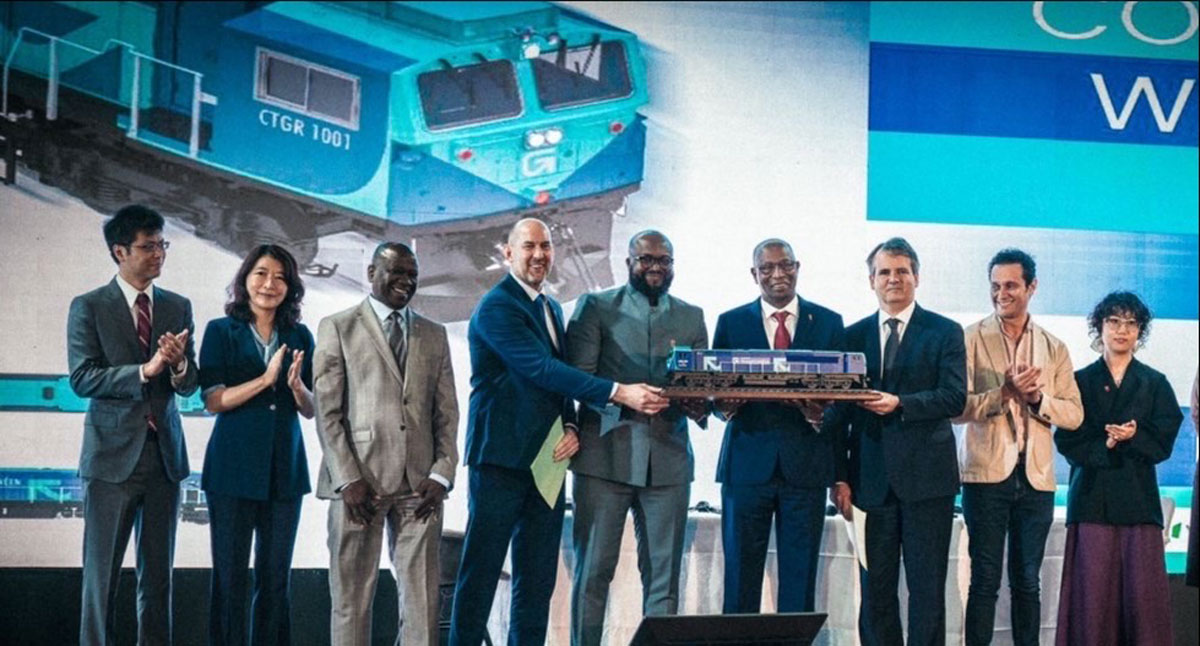
Guinea marked a historic milestone this week with the inauguration of first iron ore production from the US$20 billion Simandou project — a development expected to reshape global supply chains and redefine competition in the high-grade iron ore market. But even as the world’s largest untapped iron ore reserve moves closer to full commercial production, a rejected shipment of Chinese-built locomotives has cast a shadow over the celebrations, highlighting the complex geopolitical dynamics surrounding the project.
According to senior Guinean officials, a shipment of 18 locomotives destined for the Winning Consortium Simandou (WCS) was turned away at the Port of Conakry in September for violating the project’s co-development agreement. The pact, negotiated over several years, requires that locomotives used for the 650 km TransGuinean Railway be sourced exclusively from US-based Wabtec Corporation. The Chinese-built units were subsequently shipped back, underscoring the government’s strict interpretation of the terms.
Authorities insist the decision was not anti-China but rather an enforcement of contractual commitments. Under the co-development structure, specific components — locomotives, signalling systems, crushers, and engineering services — must be supplied by companies from designated countries to ensure technical quality, political balance, and long-term sustainability. The Rio Tinto Simfer JV, which operates Blocks 3 and 4, received its first Wabtec locomotives in October, in line with these requirements.
For mining companies and investors, the incident is an important signal: Guinea is prepared to enforce agreements with unusual rigor, even when doing so risks short-term delays to one of the most strategically significant mining developments in the world. Senior officials reiterated that President Mamady Doumbouya’s strategic committee monitors compliance “every 24 hours” to ensure that all commitments are executed exactly as written.
This level of oversight reflects the stakes involved. With an estimated 3.3 billion tonnes of exceptionally high-grade ore, Simandou has the potential to reshape the iron ore industry by supplying significant volumes of “green ore,” which can reduce CO₂ emissions in steelmaking. Its successful development also hinges on the integrity of a highly complex, multinational engineering effort involving companies from China, France, Germany, India, Australia, and the United States.
Guinean mines minister Bouna Sylla highlighted that the insistence on Wabtec technology was not arbitrary. The US manufacturer’s locomotives are already widely used in global mining operations, including in Guinea’s bauxite sector. Moreover, the choice was influenced by historical precedent: Alcoa’s early post-independence investment in 1968 set a long-term benchmark for reliability and performance.
The project’s diversity — Alstom for signalling, Egis for engineering oversight, German suppliers for crushers, and Wabtec for locomotives — is seen by government officials as a deliberate effort to design a durable, high-quality infrastructure base that will revert to state ownership after 35 years. “We are bringing together the best components from everywhere,” Sylla said, stressing the need to avoid inheriting assets that would be costly to maintain.
Insights for mining companies:
- Guinea’s regulatory and contractual environment for strategic assets is becoming more stringent. Compliance with co-development terms is non-negotiable.
- The government’s multi-power balancing strategy means procurement rules will remain tightly controlled and geopolitically sensitive.
- Investors should anticipate close state oversight of logistics, procurement, and construction to avoid delays.
- High-grade “green ore” from Simandou will likely alter long-term market dynamics, increasing competition for environmentally preferred iron ore products.
As Simandou enters its operational phase, the locomotive dispute serves as a reminder that while the project is advancing, its governance and strategic priorities will continue to shape how mining actors operate in Guinea.