


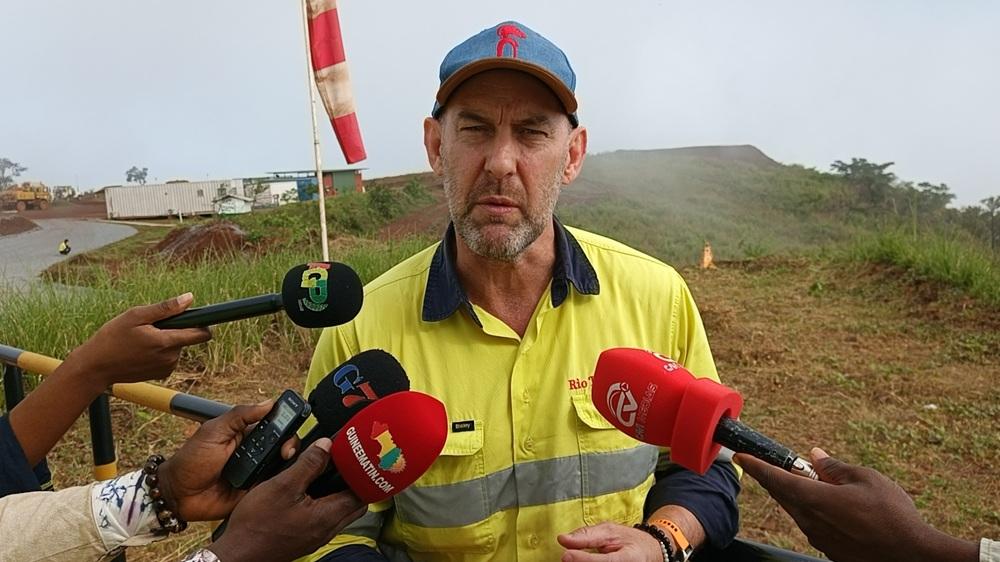
As the Simandou iron ore megaproject advances toward a long-awaited operational reality, Rio Tinto Simfer is asserting its leadership on blocs 3 and 4 through a combination of technical rigor, disciplined project management, and sustained investment. With the project now entering a decisive execution phase—mine development, a 670 km trans-Guinean railway, and a deep-water port all under simultaneous construction—the company’s operational philosophy under Managing Director Chris Aitchison is becoming increasingly central to the project’s trajectory.
A Project Where “The Sun Never Sets”
During a recent field visit, Chris Aitchison emphasized the exceptional complexity and ambition of Simandou. His description—“the sun never sets at Simandou”—captures the unprecedented coordination underway across dozens of work fronts. Forty-one nationalities are currently represented on the project, reflecting the scale and multidisciplinary demands of building a fully integrated mining and logistics chain from scratch.
This is the first time in Guinea’s mining history that mine development, heavy rail construction, and port infrastructure are being executed in parallel under a unified industrial plan. For mining companies monitoring Simandou’s progress, this integrated approach is perhaps the most strategic insight: Rio Tinto is not simply developing a mine; it is building an end-to-end export ecosystem designed to operate at world-class standards from day one.
Aitchison underscored the importance of strict deadlines ahead of the government’s planned official launch in November. The message to industry is clear: execution discipline and inter-stakeholder synchronization will define which players are able to capitalize on Simandou’s opening and which ones risk operational exclusion.
A Standard-Setting Model for ESG Integration
Beyond engineering, Rio Tinto Simfer is reinforcing its position as an ESG benchmark within the Guinean mining landscape. In the words of Sidiki Koné—Contractor Management Excellence Director and a veteran geologist on the project since 1998—no contractor is allowed on-site unless it meets strict thresholds in health, safety, environment, and community engagement.
Koné explains that Rio Tinto’s contractor approach operates as a filtering mechanism:
- Companies must review and fully comply with Simfer’s corporate approach document.
- Underperforming or non-compliant firms are immediately removed from consideration.
- Even international firms new to Guinea are required to align with Simfer’s ESG architecture before being permitted to operate.
For mining companies eyeing opportunities linked to Simandou, this is a critical takeaway. Rio Tinto is effectively professionalizing the contractor ecosystem around the project. Firms that succeed in this environment will be those capable of meeting global-standard compliance requirements—not only on paper, but in operational practice.
Interestingly, Koné notes that several companies operating in Guinea have “learned from Rio Tinto”—a sign that Simfer is influencing broader industry culture, reshaping local expectations and raising performance baselines across the sector.
Strategic Resilience and Long-Term Commitment
A recurring theme in Koné’s remarks is Rio Tinto’s longevity and strategic patience. Contrary to popular narratives suggesting periods of withdrawal, he insists that Rio Tinto “never left Guinea,” maintaining a core presence even during years of inactivity and political or security turbulence. At the height of past instability—including rebel incursions—Simfer maintained essential operations to ensure continuity.
For investors and mining executives, this affirmation signals two important insights:
- Rio Tinto views Simandou as a generational asset, not a short-term speculative venture.
- Operational resilience is embedded in the project’s governance, reinforcing confidence in the company’s capacity to navigate Guinea’s cyclical political and logistical challenges.
This long-term posture is also a competitive signal: players seeking to operate around Simandou must be prepared for endurance, not opportunism.
Implications for Mining Companies and Stakeholders
Simandou’s current phase presents both opportunities and competitive pressures for mining operators, contractors, and service providers:
- Compliance will determine access. Firms unable to prove ESG maturity will be filtered out early. This is already happening.
- Integration is now a prerequisite. With the mine, railway, and port being developed as a single system, contractors must align with centralized planning, real-time data flows, and strict scheduling.
- Capacity building is essential. The presence of 41 nationalities highlights the global competition for skills; local and regional firms must invest in training and technical capabilities to remain relevant.
- Strategic partnerships will be increasingly valuable. Companies that align early with Simfer’s standards and processes will be better positioned to win multi-year contracts once production ramps up.
A Defining Moment for Guinea’s Mining Future
As the Simandou project accelerates, Rio Tinto Simfer is emerging not only as a mining operator but as a system architect shaping the industrial, logistical, and ESG framework of what will become one of Africa’s most transformative mining corridors. Aitchison’s leadership and the consistency described by Koné underscore a project moving with clear intent, robust governance, and long-term strategic vision.
For mining actors watching from across the region, Simandou is no longer a hypothetical. It is rapidly becoming a production-ready reality—and those who understand its operational logic today will be best positioned to engage with the opportunities of tomorrow.